
Why Many FedEx Route Buyers Overpay (And Don’t Realize It Until It’s Too Late)


The Mistake Isn’t Carelessness — It’s Misalignment
Most FedEx route buyers don’t walk into a deal trying to overpay.
They do their research.They review the financials.They ask questions.
And yet—many still end up paying more than the business is actually worth.
Not because they’re careless.
But because they’re looking at the wrong numbers.
The Problem Starts With How Deals Are Presented
Most FedEx route listings are built around a simple narrative:
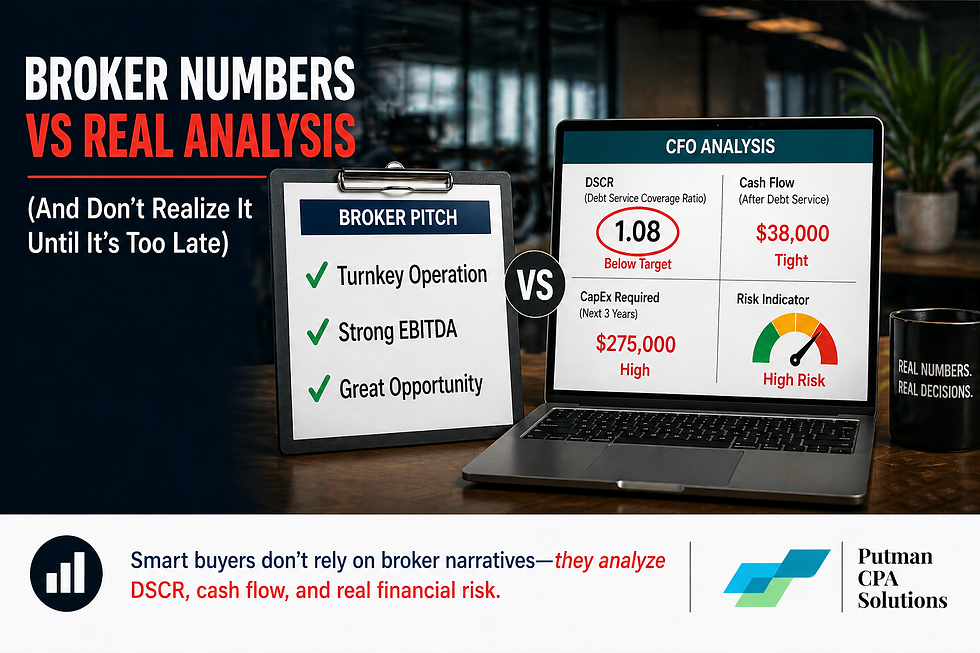
“Strong EBITDA”
“Consistent historical performance”
“Turnkey operation”
On the surface, it sounds compelling.
But underneath that narrative is a fundamental issue:
👉 The numbers being presented are designed to sell the deal—not evaluate it.
EBITDA Is Not the Business You’re Buying
EBITDA gets used as the anchor for valuation.
But EBITDA doesn’t reflect:
Truck replacements
Debt obligations
Labor instability
Real-world operating friction
It’s a simplified view of profitability—not a measure of survivability.
A deal can look strong on EBITDA and still fail under real-world conditions.

Where Buyers Start to Lose Ground
The typical buyer process looks like this:
Review broker financials
Accept adjusted EBITDA
Apply a multiple
Submit LOI
What’s missing?
Cash flow validation
CapEx planning
Debt capacity analysis
And that’s where overpayment begins.
The Silent Deal Killer: Fleet CapEx
Every FedEx route is a fleet business.
That means:
Trucks age
Maintenance increases
Replacements are inevitable
But most deals are evaluated as if those costs are minimal—or distant.
They’re not.
They’re predictable. And they’re expensive.
If you don’t model fleet replacement, you’re not evaluating the deal—you’re guessing.
The Second Risk Buyers Underestimate: Labor
Labor isn’t static.
It moves with:
Market wages
Driver availability
Turnover pressure
A deal that works with stable labor assumptions can quickly break when those assumptions shift.
And they almost always do.
The Missing Layer: Debt Capacity
This is where most buyers completely miss the mark.
They focus on:
Purchase price
EBITDA multiple
Instead of:
👉 Whether the business can actually support the debt used to buy it
This is where DSCR (Debt Service Coverage Ratio) comes in.
And it’s the metric lenders care about most.
Why DSCR Changes Everything
DSCR answers a simple question:
👉 Can this business generate enough cash to safely cover its debt?
Not theoretically.
Not optimistically.
But consistently.
If the answer is “barely” or “maybe,” the deal is fragile—regardless of how good the EBITDA looks.
What Overpaying Actually Looks Like
Overpaying doesn’t show up immediately.
It shows up over time.
Cash gets tighter
Repairs increase
Margins shrink
Stress builds
And suddenly, what looked like a solid deal becomes a constant financial strain.
A Better Way to Evaluate the Deal (Before LOI)
Before submitting an LOI, the focus should shift from:
“What does the deal show?”
to:
👉 “What does the deal actually produce under real conditions?”
That means analyzing:
Cash flow after CapEx
Cash flow after debt
Fleet replacement cycles
Labor variability
Downside scenarios
The Bottom Line
Most buyers don’t overpay because they lack discipline.
They overpay because:
They rely on surface-level metrics
They trust incomplete narratives
They skip the deeper analysis
Final Thought
You’re not just buying a business.You’re buying a system that has to work under pressure.
And if it doesn’t hold up under real-world conditions, the price you paid won’t matter.
Independent review. No broker affiliation. Confidential.
If you’re evaluating a FedEx route and want to understand what the deal actually looks like before submitting an LOI:
👉 Start with a second set of eyes.


Comments